Last week I was pleasantly surprised when I came across a magazine in the library reading room called XL Semanal that had American A-list stars on the cover of every issue.
Not used to seeing names and faces I recognized, I picked up one issue and ended up skimming and reading feature articles from three different issues (Rihanna, Harrison Ford, and one other I can't remember). The magazine drew me in in its appearance, American-look and reader-friendliness.
I snatched the Harrison Ford issue so I could finish reading it later and have it to look at for this post. The magazine has a very clear, simple cover. Easy block font, only two stories promoted on the cover, big writing in all caps, it's not cluttered and doesn't overwhelm the reader at first glance.
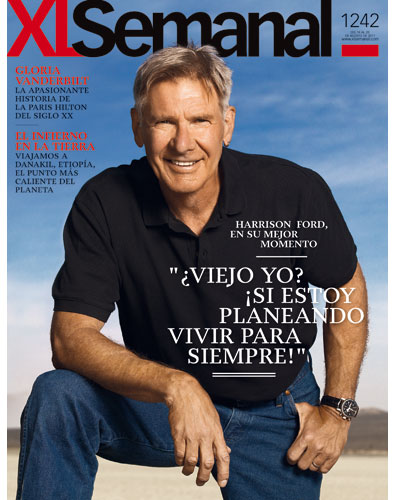
The magazine also has a relatively small size at only about 75 pages. For the bodies of text, it's a nice sized Times New Roman with plenty of white space around the page border so nothing feels crammed and it's easy on the eyes to flip through and read bits and pieces fast. The letters definitely seem slightly larger and with a little more space in between each than I'm used to in many U.S. magazines.
Though the Harrison Ford issue looks like it could be the cover of the AARP (American Association of Retired People) magazine, it seems to be a nice mix of a couple entertainment, variety, art, leisure and news stories.
I couldn't really think of an exact equivalent in the U.S. because I only read a couple magazines. It seemed like part Entertainment Weekly, part The New York Times Magazine--if you combined those two and the product was somewhere in the middle.
Put another way, it reminded me of a very simplified, boiled down, and abridged Vanity Fair in the variety of story content. This issue alone had stories about Harrison Ford, a heat wave in Ethiopia, airplane crashes, Cindy Crawford, Gloria Vanderbilt, and Libyan soldiers.
I think that's a nice balance of light, glamourous entertainment content with serious political, economic and international issues. There were also several opinion editorials in the front about news and current affairs, similar in appearance to TIME, Newsweek or New York Magazine...
The graphic design was great, lots of color and pictures but a nice balance of text to accompany the visuals in various sizes, fonts, diagrams, headlines and graphics. The feature stories all had several large high-quality full color photographs with detailed captions which I enjoyed looking at.
I liked that a lot of important quotes were bolded and that the writing style seemed concise and succinct, telling the story in a reasonable amount of words. I could for the most part understand and get the gist of most any story I read as I tried to translate it into English. The lack of high-level vocabulary was nice for me.
Some phrases and vocab thrown in puzzled me because I haven't read Spanish magazines and am not familiar with the writing style, but there were enough words and constructions I did know, I think I got the important points from the feature and shorter sarticles.
All in all, I highly recommend this magazine for anyone with a reasonable knowledge of Spanish--interesting stories that appear to be well-written, great visual appeal with graphics and nice pictures and the spacing of all the content, and articles at a very reasonable length!
Saturday, December 3, 2011
Monday, November 14, 2011
The Presidential Debate, Part 2
Nov. 7, 2011
It seems like the process of campaigning and running for national political office is very similar in any European, U.S., or developed country in general. Each candidate takes much of the same steps and jump through all of the same hoops to convince the public that he or she is the right person for the job.
The candidates for President of the Government in Spain even look like ones you'd see in the U.S.: white, middle-aged men with slightly graying hair. The language may be different here, but they still dress the same, talk animatedly and passionately in front of large crowds in front of a podium in convention centers, with big signs, streamers, and the rest etc. (For some examples of this, see the media in my last post).
It is of note that the election here is in an odd year, 2011, like some other countries in the EU. I arrived in Ireland October 27th, the day after they elected Michael Higgins as President (although in that country, the Prime Minister has much more power in political matters). Although there were signs on streets everywhere around Dublin, our tour guide said he didn't know or care who won the election because there the President is largely a figurehead and mostly a "ceremonial" position in the words of Wikipedia.
And the debate starts at 10pm here, at least an hour or two later than any major political debate would start in the U.S. This is because, like most anything in Spain, everything is pushed back and delayed a bit later time-wise than in the U.S and much of the rest of the world.
I've touched on this a bit before, but I'll say it again as it's important to note some unique traits of television media consumption here in Spain: primetime here doesn't start until around 10 pm and it goes until 1 am! These are approximate figures I've been told, but actually most primetime original entertainment programming (or news show, movie, or anything else) now starts at 10:15 pm.
This was an official change the country made in the last few years, but many channels don't stick to the standard, some even pushing back showing their top shows until 11 pm, to protect programs from the competition and monster ratings sporting events draw (i.e. fútbol games, Spain's national baloncesto team, etc.). By that time in the U.S., primetime is done, and people are getting ready for bed as news and late-night talk shows come on.
Another strategy several channels use here to delay the start of primetime is by scheduling a less popular show to start at 9:45 pm so primetime is thus forced to start after 10 pm.
The rough equivalent (if you can call it that) of the 6 o'clock news in Spain is the 9 o'clock news! Primetime in Spain was apparently at least an hour earlier in the 1990's, but has been logically pushed back as Spaniards start work later, eat a long lunch later (from 2p-5p, effectively and uniquely giving Spain a SECOND primetime that draws high TV ratings in the afternoon!), and thus ending work later creating a rush hour at 7:30 or 8 pm.
The bottom line: the standard 9-5 does not apply here. Spaniards go to bed late and many stay up late watching TV, long after those in other countries would've turned the TV off for reasons previously mentioned.
Getting back to the political matters of the upcoming election, now I'm seeing the ads for the parties, back to back on public TV channel 1, and even pop-ups on Spotify (compliments of a Spanish IP address on the apartment's Wi-fi network, all the ads are in Spanish!)!
The PSOE (Socialist Party) ad campaign features bright red background with the tag line "pelea por lo que quires. vota PSOE.", translating to "find for what you want". A recent TV spot showed Rubalcaba lecturing a small group passionately about fostering hope, creating jobs, making a better future for the children of today.
It evokes a bit more of a sense of desperation, as at this point Rajoy virtually has the majority of politicians on his side, was viewed universally to have performed better in the debate, and is the heavy favorite expected to win.
Here's a particular striking ad the party has run recently, an attack ad saying the other party is enabling and communicating the message that the rich stay rich and the poor stay poor so they can work for the rich, enforcing the lack of economic mobility and that you are born into the money your parents have. I found this ad accidentally, but my teacher made a point of bringing it up in class:
In a marked difference, on the other hand, the PP ads currently running are much more upbeat and relaxed. To light music they feature a montage of smiling citizens holding up signs about things the PP (Conservative Party) will do well for the country.
The Partido Popular's print ads have bright blue backgrounds. Unlike the harsh indoor, interrogation-room like fluorescent light source illuminating parts of Rubalcaba's body amidst the shadows, these ads show people outside, standing on grassy landscapes, with golden sunlight bathing the background. The tones couldn't be more different.
The exact ad I saw on television the night of the debate I cannot find posted online, but here is one similarly bright, hopeful, and positive in tone (visual/audibly/literally and figuratively):
The Presidential Debate, Part 1
Nov. 7 /2011
There is a debate for the upcoming election of the Prime Minister on TV tonight. Except for the fact that this election seems to be less of a major deal and event that consumes the entire news media for months on end, I see a lot of similarities with American presidential elections.
The debate in appearance and coverage is similar to a U.S. presidential debate. The woman who does the evening nightly news on Channel 1 is broadcasting from a mobile studio outside the venue of the debate.
There's a countdown clock, lots of checking in with correspondents in various places and one representing each major party/side of the debate. Tons of packages are shown of highlights profiling the race and each of the candidates, as well as showing clips from other presidential/prime minister races in Europe and the U.S., which also look similar.
This is a clip from earlier that day:
The candidates from two major parties are facing off, the Partido Popular or PP (the Popular Party, represented by Rajoy) and the Partido Socialista Obrero Español or PSOE (the Socialist Workers' Party, represented by Rubalcaba), similar to our Democrats and Republicans. They're talking about the same issues candidates do anywhere else, with a big focus on the economy in its current dire state.
It's nice that there doesn't seem to be as much hype, fluff, and gossip in the coverage of the candidates. We don't see stories every other day about personal matters or past affairs or jobs or mistakes they made in the army or in college decades ago like we do in the months building up to an election in major U.S. newspapers.
I even saw a clip of one candidate driving himself around in his own little personal Mini Cooper-like coupe--that'd be unheard of in the U.S., where party candidates would be surrounded by an entourage and security cards, and travel in a fleet of armored cars or on a big bus.
The appearance and the format of the debate is similar---I don't know if there have been many at all or if this is the final one, as the election is in just two weeks apparently. The campaigns here are much shorter: the candidates did not have any televised debate before today. And the month before the election is still called "pre-campaign."
I heard my house-mom ask her son-in-law if he's even going to vote! The way she asked it was telling: as if she genuinely was not sure and the answer either way was equally probable because the action didn't really matter. elections here don't seem to be as influential or strong a presence among citizens in the society, even though I'm in the capital city. This could be because the King of Spain still retains much power regardless. I've seen several stories on the royal family in the news.
But still, visually and content-wise, the process of running for office seems much of the same. On the public news network broadcast on Channel 1 ("La Una"), they're showing video clips and highlights narrated by political correspondents of various appearances, rallies, meet and greets, and speeches each candidate has made in various parts of Spain talking about issues of national interest the country faces.
See a highlight reel of the debate here [RTVE].
TV Commercials
I love this Cola-Cao commercial for the Cocoa powder here popular with children for making chocolate milk, and used for hot chocolate for everyone. There's bits of chocolate raining from the sky. It looks like volcanic ashe, but it's supposed to represents the pieces of solid chocolate that remain at the bottom of the glass of chocolate milk even after you've mixed it. As they don't dissolve, it shows the little kids eating them with spoons, smiling broadly.
Here is the spot:
Here's an ad for clever cross-promoting with a popular show among the target audience of young kids: "Bob Esponja"! AKA the USA's Spongebob Squarepants in Spanish:
I just found this other interesting commercial for Cola-Cao from a couple years ago. They've run a bunch of different ads over the years, and especially as a tennis fan and knowing how beloved Rafa is in Spain, I get a kick out of the parallel this commercial draws, which makes for a good story, but is pretty bogus and unrealistic in actuality.
I found a 1990 ad online in Russia that stuck with the similar theme of showing Cola Cao the fuel for a healthy body and strenuous physical activity, showing a figure skater, and another more recent one telling the story of a young surfer who seems to endorse and drink Cola Cao often before she gets exercise (as part of a healthy diet is probably thrown in there somewhere..Cola-Cao is good, but I doubt it's that nutritious):
And here's the star of that commercial making an appearance on "El Hormiguero"!
Watching TV here, I also can't help but notice how on any channel except TVE Channel 1 (Spanish public television) the commercial breaks are so LONG. They may not be as frequent as on American TV, and sometimes on the talk shows you see a feed of the studio during the break (like on "El Hormiguero"), but six minutes or more is a long time to have ads playing when you're waiting to get back to your show or movie. Thus following unsurprisingly, the scheduling format is also different; many shows and movies start on the quarter-hour here.
My housemom sometimes sits and watches the commercials, and maybe many Spaniards do, but if it were me, I'd get up, do something else and come back. I like commercials, but if I watched TV regularly, I'd tire of seeing so many at one time, and seeing the same ones over and over again.
TVE doesn't do conventional commercials for private companies and their products, but cleverly fills up 3 or 4 minutes of commercial breaks with promos for their own programming or PSA's from the government or various non-profits. However, according to WIkipedia, they showed advertisements from external private firms to fund themselves through 2009.
Lastly, I couldn't help but be shocked today when I see a full-page ad on the newspaper with the slogan "Sexo es vida." In the U.S., this would only be a small add with fine lettering tucked in the back amidst ads for other sexual remedies on a page by the classifieds and direct-mail products. The same goes for storefronts I see with pictures of topless women. I think I approve of the more open, less taboo-fearful and censored culture here, but it's not what I'm used to.
Saturday, October 22, 2011
Newspapers & Their Front Pages (Ads ads everywhere!)
I was shocked. The last couple days I've picked up the local daily newspapers here, three out of three have had a full-page ADVERTISEMENT on the front page.
It took me a second to realize one of them was an advertisement because they made the headline look like a newspaper header. However, the red logo of the newspaper ("Qué es!") was rotated ninety degrees for that issue on the page that was part of the sort of alternative reality campaign.
Here's an example of an alternative reality brand advertisement meant to promote "The Dark Night" by seeming like a page taken from an actual police report.
The label of "publicidad" (advertisement) is also not very visible; it's very small and tucked away in the corner. I've gotten all three of these newspapers several times before and this is the first time I've seen it.
I've noticed that advertisements on the front pages of newspapers are also creeping up into American newspapers who are desperate for higher ad revenues. Still, I don't think I've ever seen an ad in a U.S. newspaper take up more than half of the front page.
Besides the ad, which corresponded to a supplementary full-page ad for the same product on the backpage of these small dailies (each around tabloid size with around twenty or thirty pages including many ads), the paper was normal.
You turned the page and saw the actual first page with the real header, information about the newspaper, and all the day's headlines.
It should be noted that all three of these newspapers were small, free dailies, not the larger, more serious and in-depth newspapers with more detailed coverage, longer articles, and meant for a more sophisticated, politically and foreign affairs-savvy audience (like El País or El Mundo for example).
Although interestingly enough, as The New York Times often does on their website, clicking to El País' or El Mundo's website right now will take you to a full-page animated ad you have to navigate away from to view the actual news content.
The two newspapers that I have seen with front-page ads are Qué es! and 20 Minutos. On Friday, October 21st, 20 Minutos had a full-page front and back ad for the stage show of The Lion King opening up in Madrid.
Qué also had an ad that same day for the movie "La Cosa" ("The Thing" in English-speaking countries). Two days earlier, it had one for the movie "Las Aventuras de Tintin: El Secreto del Unicornio" ("The Adventures of Tintin: Secret of the Unicorn" in America), which consisted of the front page of a fake newspaper The Daily What on the first page and the "Tintin" movie poster on the back page.
Proper Nouns in Spanish
Also, building on my previous post, I was surprised to find out that a lot of proper nouns, especially names of works in Hollywood or famous actors, are not translated into Espanol.
George Clooney is not Jorge Clooney. Mr. Bean is not Señor Bean. Most amusingly, my host mom's son-in-law, gave me an incomprehensible look when I mentioned the movie "La Guerra de Las Estrellas" (literally in English: The War of the Stars). They call it "Star Wars" here (albeit in that slight Spanish accent: "se llama Stahr Woors aquí" (phonetic spelling)!
Of course, this won't stop you from watching the Star Wars movies with Spanish dialogue:
And Facebook: it's also just called "Facebook" here by Spanish speakers--not "El Libro de Caras" ("The Book of Faces") as I hilariously once told a native Spanish-speaking student.
Again, although the name of the site doesn't change, you can still have the rest of Facebook translated into about virtually any language under the sun by changing your preferences or going to the right IP address.
I wanted to bring up the social network and ask about it in another language for the first time; he gave me the same puzzled look in response and explained they also just refer to it as by the brand name here. We both had a good chuckle after that.
I guess some names are so iconic and widely recognizable, there's no need to translate from language to language!
El Hormiguero (Part 2)
September 26, 2011
The show seems to be so popular and respected here (maintaing a position as the dominant talk show standard), that it seems to be the place where all Hollywood celebrities, politicians, athletes, authors, musicians and the like to go to when they are on a promotional tour doing talk shows in various countries around the world. In addition to domestic celebrities popular in Spain, there's a lot of international, globally recognizable stars.
El Hormiguero 3.0 is all in Spanish but a lot of the guests don't speak Spanish very well, as many are American. Mr. Bean is British (I think) and he needed to have every word said by the host or the assistant cast members translated from fluent Spanish.
So Rowan Atkinson wore an internal audio speaker in his ear so that every word spoken on the show in Spanish was fed into his ear in English. You could see, as he was 'listening', he wasn't looking at the guest or cast member that was speaking, but looking straight ahead or down, trying to concentrate on hearing and understanding the English words being transmitted into his ear.
Then, once he got it and heard the phrase/sentence when the talent was done talking, he'd look up and start responding in English. There was a slight delay after he did this, and then a prominent voiceover translated his words into Spanish as he was talking to the host or talent, the English heavily muted. They use this same method for translating any non-Spanish language audio on the news and in English-voiceover commercials.
Then similarly, the host also wore an earpiece microphone where he would hear the translated words too--but he was used to doing this, so it didn't look as much like he was concentrating on trying to listen and understand words that were not in the room. Like a news anchor, he made it seem like he was only paying attention to voices on the studio floor he was in, maintaing an engaged look.
However, the French David Guetta was proficient and didn't need a translator and could sentences in Spanish a bit slowly and understand whoever was speaking. The Spanish chef obviously had no problem speaking only in Spanish, his native language.
Here you see David Guetta can get by in Spanish and only occasionally does the translator VO come in (the voices in the background are the ant puppets providing silly commentary):
The show is fun, funny, and well-produced with a sophisticated set, gadgets and technology, demonstrations, and entertaining interactive guessing games where the audience can play along at home too. I enjoy it a lot and wish there was something more like this on network TV in the U.S. in English right now!
If you want to see more video clips, you can find them here.
The show also has its own Facebook page.
El Hormiguero (Part 1)
September 26, 2011
Tonight I watched the late-night talk, entertainment, and variety show "El Hormiguero 3.0," which literally translates to "anthill" or "ant's nest." It's pretty different from late-night shows in the U.S. Besides it being more than a simple talk show, the style is sillier, more informal, and casual, like almost a variety show with a little stand-up and slapstick comedy. It's actually on at 10pm or 10:30 i believe but there's nothing I can think of like this in primetime in the U.S. now, so I'll refer to it as late-night for now, as the format is similar.
The host is younger and not dressed in a suit like Jay Leno, David Letterman, Jon Stewart, and Stephen Colbert, but in a simple collared shirt with the top button opened. The host, Pablo Motos, is also notably young-looking, and has facial hair (a no-no to be on-air in the U.S.). Also notably, there are alien-looking puppets (supposed to be ants) that pop up in front of the desk and talk to the host and the guest, a bit like hecklers from the tone I gathered of what they were saying.
Then there's a cast of characters that comes out and participates in various interactive challenges, games, demonstrations--tonight they used some optical illusions to illustrate physics and optics principles briefly.
The other night the guest participated in a skit making fun of a movie. Unlike American shows, most of the time is spent with the guest playing and participating in these various interactive guessing games, or watching the cool illusions, demonstrations, or magic tricks.
David Guetta was on the other night and they made him guess which song of his the cast member was dancing to, without hearing anything. Tonight the host took the guest, Mr. Bean (aka Rowan Atkinson) on a ride in the world's oldest car, and then a brand-new sports car, did some optical illusion demonstrations with mirrors, launched ping-pong balls through a tube while the host caught them illustrating Bernoulli's Principle, and a magician performed a trick where he made a coin and fish appear and disappear.
Más vídeos en Antena3
It's very well done and entertaining--the tricks are engaging and impressive. There is some formal chit-chat in the beginning talking about what the guest is promoting, but then the host and guest get up from the desk and start playing around or watching various exhibitions.
They also mix up the tricks and games and always seem to have a new, different, interesting entertainment that relates to the guest and their special talent, and is smartly and creatively executed. The props and devices are elaborate, advanced, and impressive-looking, appearing to be more sophisticated than the devices used on a talk show set in the United States.
David Guetta's demos (unsurprisingly) were mostly about music and dancing. One involved a DJ turntable and Mr. Guetta using a gadget to create a song using an accompanying visual illustration. There was a famous Spanish chef on the other night and he was cooking and showing how he could toss various dishes from a pan through a hoop far above him (the host tried also, but didn't do as well).
Here's a cool trick they did on David Guetta's episode:
Some are more random though. David Ferrer hit balls thrown from the audience with a racquet but also had to slide a full glass of beer across a simulated bar counter.
Tonight with Mr. Bean it was all about optical illusions, magic tricks, and silly disguise guessing games. From the few lines in the show I understand, the host and all the show's cast of sidekicks are quite funny and witty too.
There are also some comedic/satiric recorded segments shown occasionally with 'correspondents,' like The Daily Show or The Colbert Report, but most of the show does take place on a big studio floor, with the guest and host standing up and moving to different sections of the floor, or waiting as props are moved in and out.
Wednesday, September 28, 2011
S-Moda Sarah Jessica Parker cover
I was quite surprised after seeing this magazine cover to learn that Sarah Jessica Parker is dressed as a matador, a traditional bullfighter in Spain. She´s an American television and movie star, and it seems a bit random that she would be dressed as a bullfighter--as I don´t think there are any female bullfighters (but that may just be a stereotype I have, I´m not sure), at least not in Spain.
While I know it´s commonplace for the biggest Hollywood celebrities to pose for magazines and publications around the world (and international version of American publications) because of their global following, I wonder why they chose Sarah Jessica Parker to be the one who dresses like a bullfighter. It seems like they´re trying to glamorize an old cultural tradition that goes back hundreds of years in Spain.
And interestingly enough, I think it´s a commentary on America´s dominant place in world culture, and our ethnocentrism, that American stars are on the covers of publications all over the world, but you virtually never see foreign celebrities and pop culture icons from other countries on the cover of American magazines.
But that´s logical in the sense that we probably wouldn´t know the stars or even recognize the names because Americans are almost totally worried about and focused on what´s going on in our country (for the most part). After all (and I sound American when I say this) but I think we do have the best and most popular forms of art and pop culture in the world.
I also wonder why they chose that specific month to have the subject dressed as a bullfighter. It certainly is unexpected and catches your eye. Her pose is so confident with the slight tilt and position of her arms, I almost buy the idea, although it still sounds a bit preposterous.
The magazine graphic design and layout looks similar to an American publication like Vanity Fair, but it´s less busy because there´s no headlines of text covering the sides or top of the magazine cover. This cover is so clean, and only promotes one story, whereas American stores usually have like ten. The logo of S Moda is interesting because it´s vertical and oriented in the corner, not horizontal and in the top center as is common in the U.S.
Friday, September 23, 2011
Surfing the Tube
I flipped through the channels tonight and was shocked to find a modern Spanish version of the show Cheers! I couldn't really understand what was going on, but I saw the equivalent Norm, Cliff, Coach, and Carla characters. The set was similar but a bit updated and more trendy, the door had the same Cheers sign on it as the original (same design for the logo), and the characters were a bit younger. There didn't seem to be as many laughs, and it sounded like a laugh track might be used instead of a live studio audience like the original.
I couldn't believe my eyes at first but I checked the cable box info to be sure--and I was in fact watching a new version Cheers like I thought thought at first. I'm shocked Spain did a reboot of this show and doesn't just translate the old, original classic [maybe they do that too]. I wonder if it's successful--there's an article about the show here under "Cheers (España)" on Wikipedia.
Apparently it literally premiered less than two weeks ago (on Sept. 11) and the premise is very similar to the old original, except the main protagonist character who owns the bar, here called Alberto San Juan (and the equivalent of the skirt-chasing Sam Malone the ex-Red Sox pitcher on the American version) is an ex-soccer (fútbol) player instead of a baseball player. This makes a lot of sense as the classic American pastime seems pretty non-existent in Western Europe. I wonder how the critics will like it and if it will sustain a lot of viewers. Interesting choice to bring back a slightly modified, updated version of such an old, classic, iconic sitcom 25 years after the fact.
After some more channel surfing, It's also somehow reassuring and sad at the same time to know that there are the same crappy daytime TV equivalents to crappy American tabloid shows with the same dumb people with the same pathetic petty personal squabbles over who owes who child support, who had the affair, or who the dad is. I don't miss that from the States, but I found a show like that here--I couldn't bear to keep it on long enough to catch the name.
There also seems to be a handful of game shows similar to primetime ones in the U.S. I got into one called "Cara a Cara" and another called "Uno para Ganar" where the contestants had to complete small physical challenges to advance and win money. These included rolling tuna cans to knock over bottles, putting cookies in their mouth without using their hands, pulling tissues quickly out of a box, bouncing pencils into glasses, and holding a tennis racquet between their legs while trying to bounce a hard candy into a specific section of the racquet.
"Uno para Ganar" was structured very similarly and appeared much like the U.S.'s "Minute to Win It". Upon Wikipedia search, I discovered this show is in fact the Spanish version of that game show.
Lastly, I found it odd how during many of these shows (game shows, talk shows, sitcoms, dramas, etc.) commercials are abruptly broken into, without warning or the kind of transition or gradual pause, with music and a fadeout that is standard practice in the U.S.. I thought the signal was lost on the TV for a second before a commercial was abruptly cut to and in a flash the characters' dialog was cut off mid-sentence. After seeing this happen twice, I realized it was not a mistake or technical problem like I had originally thought.
Wednesday, September 21, 2011
News, Censorship & PDA
It's interesting to observe the news broadcasts here and how they're different than in the U.S. The weather reports and package segments are definitely longer than in the U.S, usually 5 minutes or more from my estimation. U.S. broadcasts are faster-paced and pack in more, shorter segments into the show. The commercial breaks are also less numerous, but four minutes instead of three.
And censorship is not nearly as strict--the other night there were b-roll shots of a beach for a story on some popular summer destination spot on the coast and there was a cut to a shot of a topless woman sunbathing a couple seconds! Though I have no problem with that :), I was shocked, but that's just business as usual here.
Another night I saw a sudden, clear close-up of a human brain being operated on. That would probably be considered a bit shocking and too explicit for a network newscast back in the U.S.
Some classmates told me that they were watching "Sex and the City" on HBO and that even a premium cable program like that was also less censored and showed more skin and explicit nudity than in the U.S. Nudity is a bit more liberal and normal here.
PDA (Public Displays of Affection) also appears to be displayed more routinely and commonly here from my daily observation. It seems every day on the metro I'll be in a car with at least one couple intensely making out, not caring if people are sitting/standing next to them three feet away awkwardly trying to ignore them.
Late one weekend night on the corner of a sidewalk by a busy road, under a bright street lamp, two people (one sitting on a small ledge) were so vigorously sucking face it was laughable. Cars drove by and we stared--don't they want to go somewhere more private? But I guess these are all cultural norms, maybe they're just bigger thrill-seekers.
Monday, September 19, 2011
Owl City & Imported Food
Saw Owl City play tonight in a small room/club menu. It was cool and nice to see a pretty big-name act, with tons of Spanish fans singing along and rocking and having a good time in an intimate setting to an American act. Spanish speakers knew all the English words (wish I could say the same for the songs I like in Spanish, but I have a hard enough time hearing song lyrics in English haha). The young lead-singer couldn't stop thanking everyone in Madrid for coming out and he appreciated their devotion and warm reception.
He repeated how it was surreal and he never thought he'd be playing for fans somewhere as far as Spain. He likes the country but it was his first time here and he hasn't travelled around here much. They seemed to understand everything he said [at least some of the audience was proficient in English], but the only Spanish word he uttered was "gracias," in a thick American accent, once.
It's nice how music can cross language borders. Speaking of accents, on the way in I was asked by the woman at the ticket window, after I spoke some Spanish and picked up my tickets, if I was from France. I have no idea why; I've never been asked that before and it's a new one on me if I sound French when speaking Spanish.
After getting home late and looking in the fridge, I was shocked to accidentally discover that my señora has the same brand of pure Vermont maple syrup in her refrigerator that my mom buys at home back in Connecticut. It's from the same company based all the way across the Atlantic in VERMONT! It's quite expensive there because it's the real deal, and I cringe and can barely imagine how expensive pure, savory maple syrup like that costs to import over here to Western Europe. If a small bottle is around $10 in the U.S., I could see it being at least 13 or 14 Euro (around $20 converted to USD) to buy in a market here. Guess syrup is one thing the U.S. has down better than other countries (somewhat unsurprisingly).
Seeing the Hollywood Flicks in Spain
Another observation here is that all culture, specifically American culture, seems to usually hit the States before it reaches here, unsurprisingly. But what is surprising is the amount of time difference in how far behind movie releases lag over here than they do in the U.S. Some movies here have the same name as in the U.S., some are literally translated, and some are given a new title in the native language which I also found interesting.
For example, "Friends with Benefits," the recent romantic comedy starring Mila Kunis and Justin Timberlake, was released in late July in the U.S. It's about to come out in Spain--in late September (about two whole months later!). It also has the title here of "Con Derecho A Roce," and I've seen previews where the acting roles are dubbed with different voices.
That title, according to my calculations and a dictionary verification, would translate to "With (the) Right to (a) Rub," or "With Right to Brush Against", or "With Right to Contact." I guess you can chalk that up to 'friends with benefits' being a uniquely English idiomatic expression for a friendship that is also a sexual relationship, while the Spanish word for 'benefit's would not be interpreted with the same meaning in that context. Beneficios evidently has a different connotation en español.
"Super 8" also came out in Spain in mid-August, when it was released in the U.S. in early June of this year. The title for that movie was unchanged for the Spanish release. But "The Smurfs" movie is coming out very soon in Spain (about a month after the U.S. version) and in Spanish it's called "Los Pitufos." Granted, smurf is not an English word, but most of the other languages the series and movie has been adopted into have closer-sounding names to the original (e.g. Les Schtroumpfs in French). How do you get Pitufo from Smurf? Does Pitufo even sound like any Spanish word? Because it doesn't sound like Smurf...
From talking to Spaniard college students at a social mixer our schools sponsored the other night, they actually much prefer to watch American movies--most people, especially young people, think Spanish cinema is too strange or surrealist.
They mostly spend their time watching the releases of mass market, pop cultural blockbusters that are wide crowd-pleasers and appeal to people all over the world [when translated into a language they can understand]. the students I talked to name some of their favorite movies and they were all from Hollywood.
I guess this isn't surprising, it's just interesting how they spend a lot of their time consuming culture and media from America (after the wait, of course) when the reverse is not true for Americans.
Observations from Dining at McDonald's
Everything is more expensive here that we also have in the U.S. McDonald's is at least a third more expensive (when you convert Euros into USD), but a plus is the ones in Madrid are modern, clean, and with chique and upscale decor: leather couches, stone walls, chandeliers and gold railings sometimes, the works. They even have a separate McCafe area for pastries that's reminiscent of Starbucks.
It even feels more like a restaurant in this city because there's usually plenty of seating upstairs with trendy-looking booths and tables. I don't know if all the McDonald's in a city like this were just remodeled, but I'm guessing that they're not all this nice in Europe. They have chicken wings, ice cream in a little wafer cone, and the Chicken Bacon Queso (?)(CBQ) sandwich I got today was on a square-shaped bun with rounded edges.
Also, the nutritional information is extremely detailed and clearly displayed, more prominent and accessible than in the U.S.'s dingy McDonald's, where you usually have to make a point to seek it out, ask someone, or go online. I knew exactly how many sugar, fats, salts, carbs, proteins, and calorie amounts, the percentage for each, and % Daily Value. I know it's bad but the fact that I know exactly how much ridiculous amount of unhealthy calories I'm eating in one sitting is a bit depressing.
Also, a friend made an interesting point that the McDonald's signs here are not gold and red--just white. She thought that might have something to do relating to the Franco regime and reminding people of bad political times, but I am not sure why the colors are missing on most of the signage and logos here.
Subscribe to:
Posts (Atom)

